
5 posts tagged with "AI Infrastructure"

AI infrastructure and data center technology

View All Tags

NVIDIA Vera Rubin Is the Most Secure GPU Ever. The Software Around It Keeps Breaking.

· 15 min read
Dhayabaran V
Barrack AI

NVIDIA's Vera Rubin platform is the most security-forward GPU architecture the company has ever shipped. Rack-scale confidential computing across 72 GPUs and 36 CPUs. Encrypted NVLink 6. A custom Vera CPU with native TEE support, eliminating the x86 dependency that limited Hopper and Blackwell. On paper, Vera Rubin closes gaps that have existed in GPU security since the first CUDA kernel launched in 2007.

B300 Draws 1,400W Per GPU. Most Data Centers Aren't Ready.

· 11 min read
Dhayabaran V
Barrack AI

NVIDIA's B300 GPU draws up to 1,400W per chip. That is double the H100, which shipped barely two years ago.

A single GB300 NVL72 rack, fully loaded with 72 of these GPUs, pulls 132 to 140 kW under normal operation. To put that number in perspective, the global average rack density in data centers sits at roughly 8 kW. So the B300 needs about 17 times the power of a typical rack. And according to Uptime Institute's 2024 survey, only about 1% of data center operators currently run racks above 100 kW.
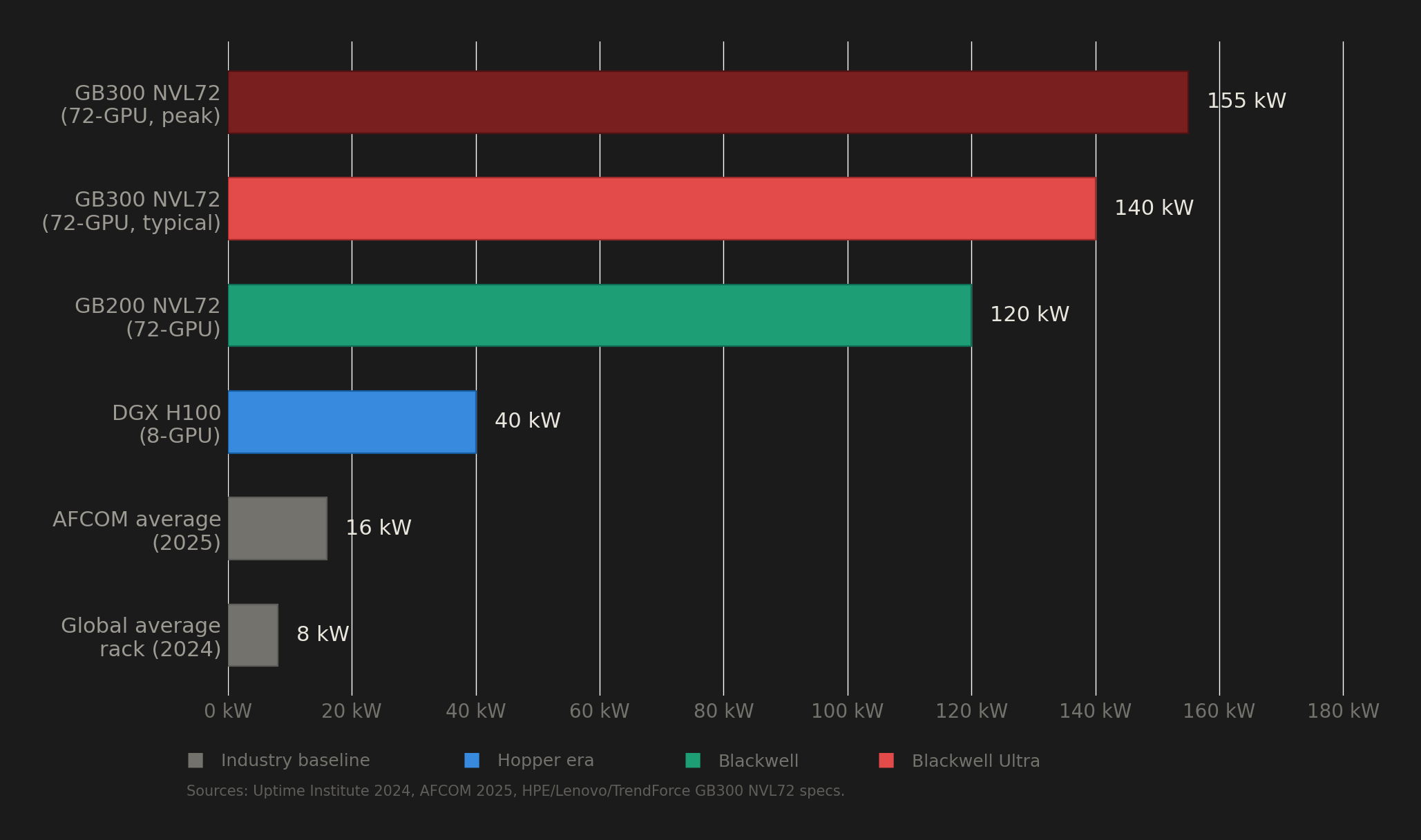
Rack power density comparison

That gap between what the B300 demands and what the world's data center infrastructure can actually deliver is the story nobody is telling properly. Behind every cloud GPU instance running Blackwell Ultra is a facility that had to solve problems in power delivery, liquid cooling, and grid access that most buildings on earth are not equipped to handle.

This post breaks down the real infrastructure cost of running B300s, the deployment problems operators have already encountered, and why the electricity grid itself is becoming the binding constraint on AI compute scaling.

GPU Rowhammer Is Real: A Single Bit Flip Drops AI Model Accuracy from 80% to 0.1%

· 13 min read
Dhayabaran V
Barrack AI

A single bit flip in GPU memory dropped an AI model's accuracy from 80% to 0.1%.

That is not a theoretical risk. It is a documented, reproducible attack called GPUHammer, demonstrated on an NVIDIA RTX A6000 by University of Toronto researchers and presented at USENIX Security 2025. The attack requires only user-level CUDA privileges and works in multi-tenant cloud GPU environments where attacker and victim share the same physical GPU.

GPUHammer is not the only GPU hardware vulnerability. LeftoverLocals (CVE-2023-4969) proved that AMD, Apple, and Qualcomm GPUs leak memory between processes, allowing full reconstruction of LLM responses. NVBleed demonstrated cross-VM data leakage through NVIDIA's NVLink interconnect on Google Cloud Platform. And at RSA Conference 2026, analysts highlighted that traditional security tools monitor only CPU and OS activity, leaving GPU operations completely invisible.

If you are training or running inference on cloud GPUs, this matters. Here is the full technical breakdown.

NVIDIA Spent $20 Billion Because GPUs Alone Can't Win the Inference Era

· 19 min read
Dhayabaran V
Barrack AI

On March 16, 2026, Jensen Huang took the stage at GTC in San Jose and unveiled the NVIDIA Groq 3 LPU: a chip that is not a GPU, does not run CUDA natively, and exists for one reason only. Inference.

Three months earlier, on Christmas Eve 2025, NVIDIA paid $20 billion in cash to license Groq's entire patent portfolio, hire roughly 90% of its employees, and acquire all of its assets. It was the largest deal in NVIDIA's history. The company that built the GPU monopoly spent $20 billion on a chip that replaces GPUs for the most latency-sensitive phase of AI inference.

This is not a product announcement recap. Every major outlet has covered the Groq 3 specs. What nobody has published is the synthesis: why the GPU company needed a non-GPU chip, what the data says about GPU architectural limitations during inference decode, and what this means for the thousands of ML teams currently renting GPUs for inference workloads.

Every claim in this post is sourced. NVIDIA's own projections are labeled as such. Independent benchmarks are cited separately.